

How Did The Women's Movement Change The Gender Makeup Of The Workforce?
Where are we at?
Co-ordinate to the Global Gender Gap Report 20201 , it volition take some other 100 years to attain gender equality based on the electric current rate of progress. This prediction has been widely used every bit a shock therapy to button governments, NGOs, associations, investors and companies into action. In the face of the Covid-19 pandemic and economical crisis, efforts will have to be doubled if nosotros are to avoid losing another 10 years to achieve gender equalitytwo. Based on past experience, economic slowdowns non merely disproportionately affect women, but besides trigger gender equality topics to slip down governmental and corporate agendas. Women represent 39% of the global workforce merely accounted for 54% of job losses as of May 20203. Furthermore, women are over-represented in sectors which are most heavily hit by the pandemic, such as hospitality or the food services industries, farther exacerbating inequalities. These inequalities likewise disproportionately affect certain groups of women, depending on the intersections of gender with race, ethnicity, religion, course, power, sexuality and other identity markers.
In 2020, the discourse has shifted significantly from a focus on gender diversity towards diversity and inclusion more generally. Still, the lack of data on other diverseness indicators and how they intersect with gender has made information technology difficult for companies and investors to measure out their performance and consistently identify gaps in the domain. As a result, most large-scale corporate and fiscal initiatives tend to still focus on mainstream gender metrics.
Financial initiatives
Financial initiatives are worth highlighting, every bit they demonstrate the development and progress made towards gender equality. In 2019, total publicly bachelor disinterestedness and fixedincome offerings in gender lens investing reached over USD 2.4 billion in asset-undermanagement4. The push to integrate gender diversity in investment criteria has increased over the years: at to the lowest degree 15 new publicly traded gender lens equity funds accept been launched since 2015. In 2017, Morgan Stanley encouraged analysts to include gender scores in their investments, while in 2018 the State Street Global Advisors announced that information technology would vote confronting all-male boards in the US, Great britain and Commonwealth of australia every bit of 2020. In 2018, BlackRock announced that it expected the companies it invested in to have at least two women on the lath and urged the Russell one thousand companies with fewer than that to human action on their lack of multifariousness. This had a direct issue, as the number of companies with fewer than two women on the board dropped by xiv% within five monthsv. In November 2019, Fox Gestion d'Actifs, a subsidiary of Groupe Premium, launched its Valeurs Feminines Global Fund, which invests only in publicly-listed companies whose CEOs are womenhalf dozen. Although this benchmark poses obvious challenges, as for example in 2020 women fabricated up almost half of the employees of S&P 500 companies but only 6% of their CEOs7, it is the start such fund and makes a strong case for more venture capital investment in women entrepreneurs.
The outlook for gender lens investing is geared to move across its current focus on large-cap companies and developed markets, to besides set up expectations on smallcap companies and in developing markets8. For example, a report published in 2019 looking into 61 companies listed on the Nairobi Securities Exchange found that 12% of these companies had women CEO's, compared to only 7% of FTSE 100 companies and 7% of Fortune 500 companies9. Including these companies in gender lens investing would therefore be an interesting perspective for the evolution of these funds.
Women on the board
Considerable attention has been directed towards the number of women at board level, and to a lesser extent, in executive positions. This has led to positive developments, as we see that the percentage of women on boards has increased across all regions over contempo years. The following catamenia charts show the proportion of companies according to the percentage of women on their board, and how the trend evolves over time. Each flow represents the percentage of assessed companies which moved between brackets from i year to the side by side.
What caused this increase in the pct of women on the board, and how can it bulldoze change inside corporations more broadly? The beginning function of this commodity 'More women on boards, and so what?' will explore some of the trends and rationales effectually focusing on women on the board. The 2nd part 'Moving up the ladder' will investigate the trends which mark other diversity indicators, namely the pct of women at different levels of responsibility and equal remuneration. The tertiary part 'Care responsibilities in times of a pandemic' will then focus on the importance of family-care policies, which can remove some of the barriers women face in their career development.
Methodology: Every year, the largest 3,500 companies in the world are invited to participate in the Corporate Sustainability Cess, for potential inclusion in the Dow Jones Sustainability Indices. The graphs in this article present the data collected through the assessment of these companies over the years.
Proportion of companies according to the percentage of women on their board
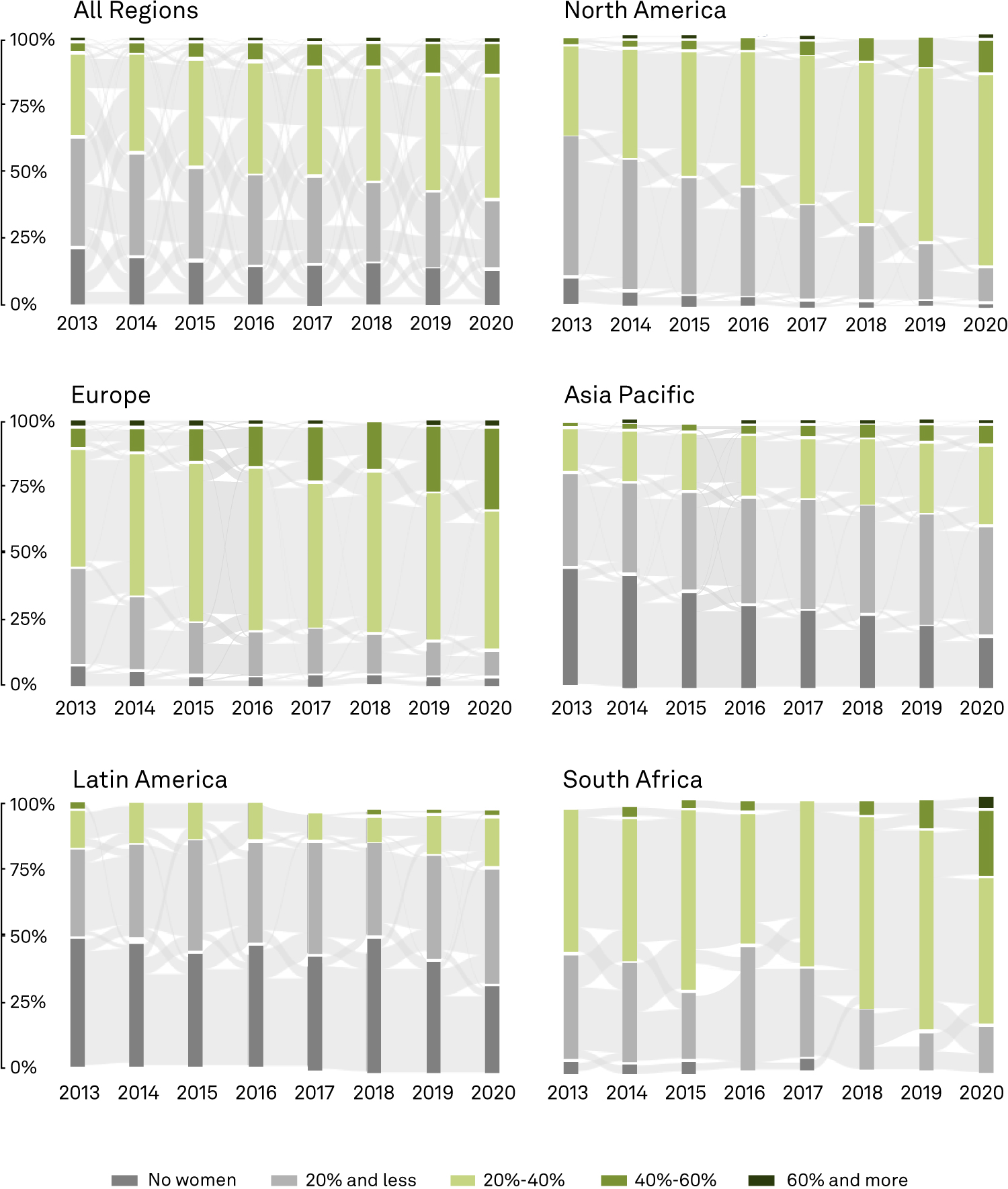
Methodology: Our universe of assessed companies in Africa is virtually exclusively composed of Southward African companies, which is why nosotros single out South Africa when analysing regional trends.
Women on boards: bound to increase?
Regulatory frameworks
Regulatory frameworks have been a driving force towards increasing gender diversity inside companies. The European Union has been the most proactive in this domain, issuing a proposal for a directive on improving the gender balance on corporate boards as early as 201210. As a issue, six Eu member-states have adopted binding quotas for gender board diversity: Belgium, Italy, Portugal, Germany, Republic of austria and France. Some other nine states have resorted to soft and non-binding quotas: Denmark, Republic of ireland, Spain, Grand duchy of luxembourg, holland, Poland, Finland, Slovenia and Sweden. The UK has also put in place soft quotas. Greece, which up until and so had a soft quota in identify, announced the adoption of a 25% bounden quota for the end of 2020. Beyond Europe, India issued the Companies Bill in 2013 which requires public companies to have at least one adult female director. Malaysia adopted a policy in 2011 for companies with more than 250 employees to have boards that are at least 30% women by 2016. Brazil is still looking into a quota for state and mixed-cap companies, which would crave them to accept boards that are at least xxx% women by 2022. In the US, California adopted quotas in 2018 for publicly traded companies, to exist reached by 2019 or 2021 depending on the size of the lath. Other countries take also adopted binding and non-binding quotas, every bit summarised in the tabular array beneath:
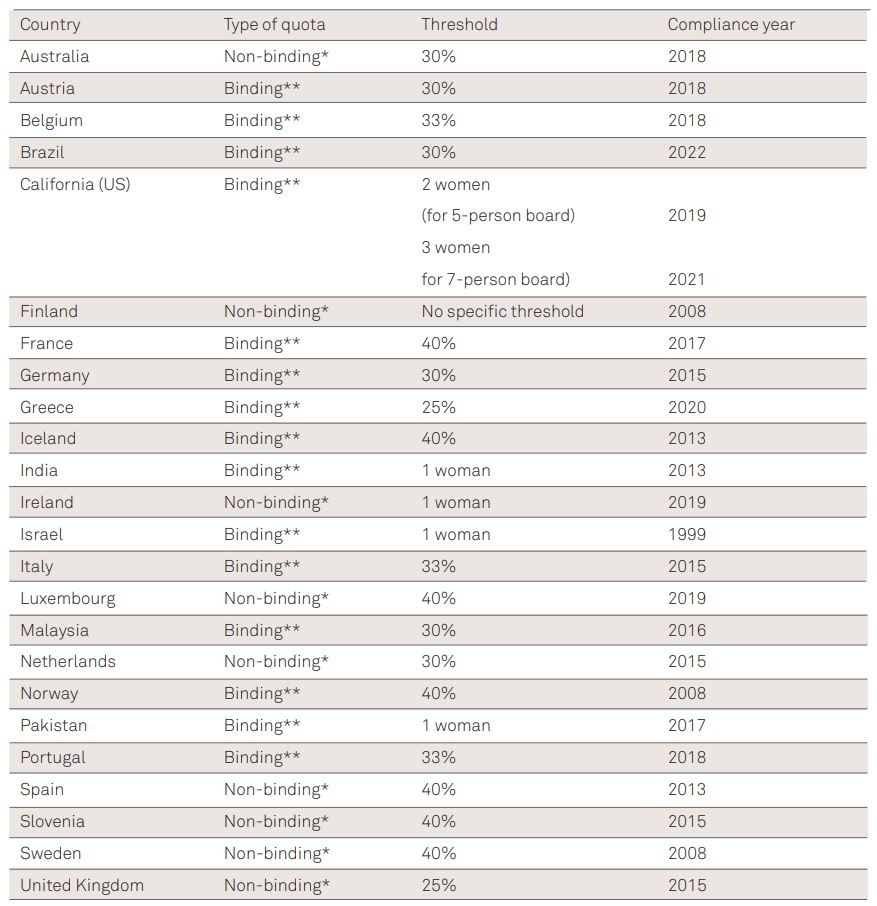
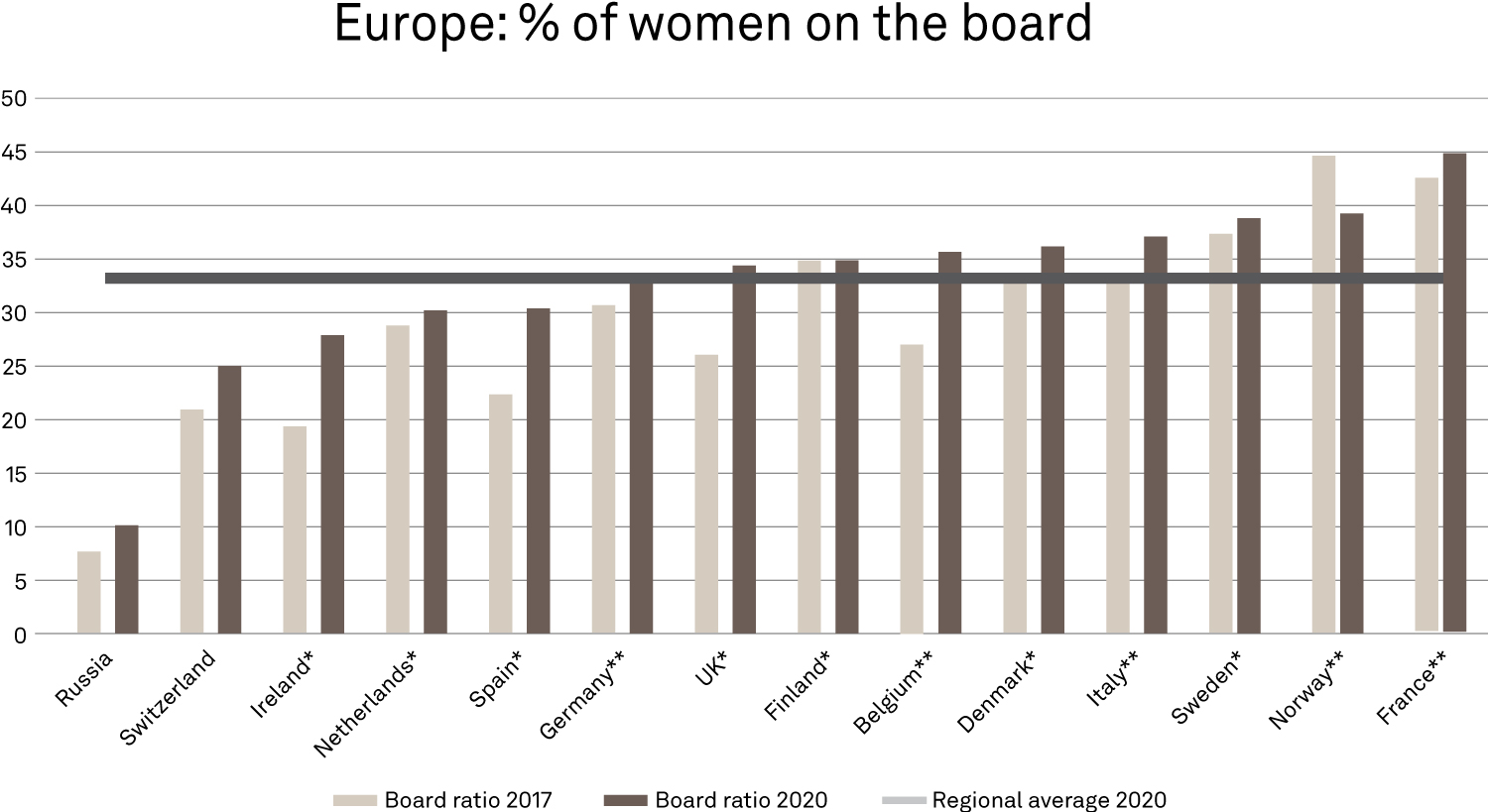
When analyzing the performance of companies beyond unlike countries within the Corporate Sustainability Cess, we see that the countries with soft and binding quotas accept performed ameliorate in terms of lath gender diversity than those which have not adopted any quotas. Indeed, European companies headquartered in countries with regulations or recommendations on the number of women on the lath mostly had an boilerplate percentage of women on the lath which was higher than the regional average.
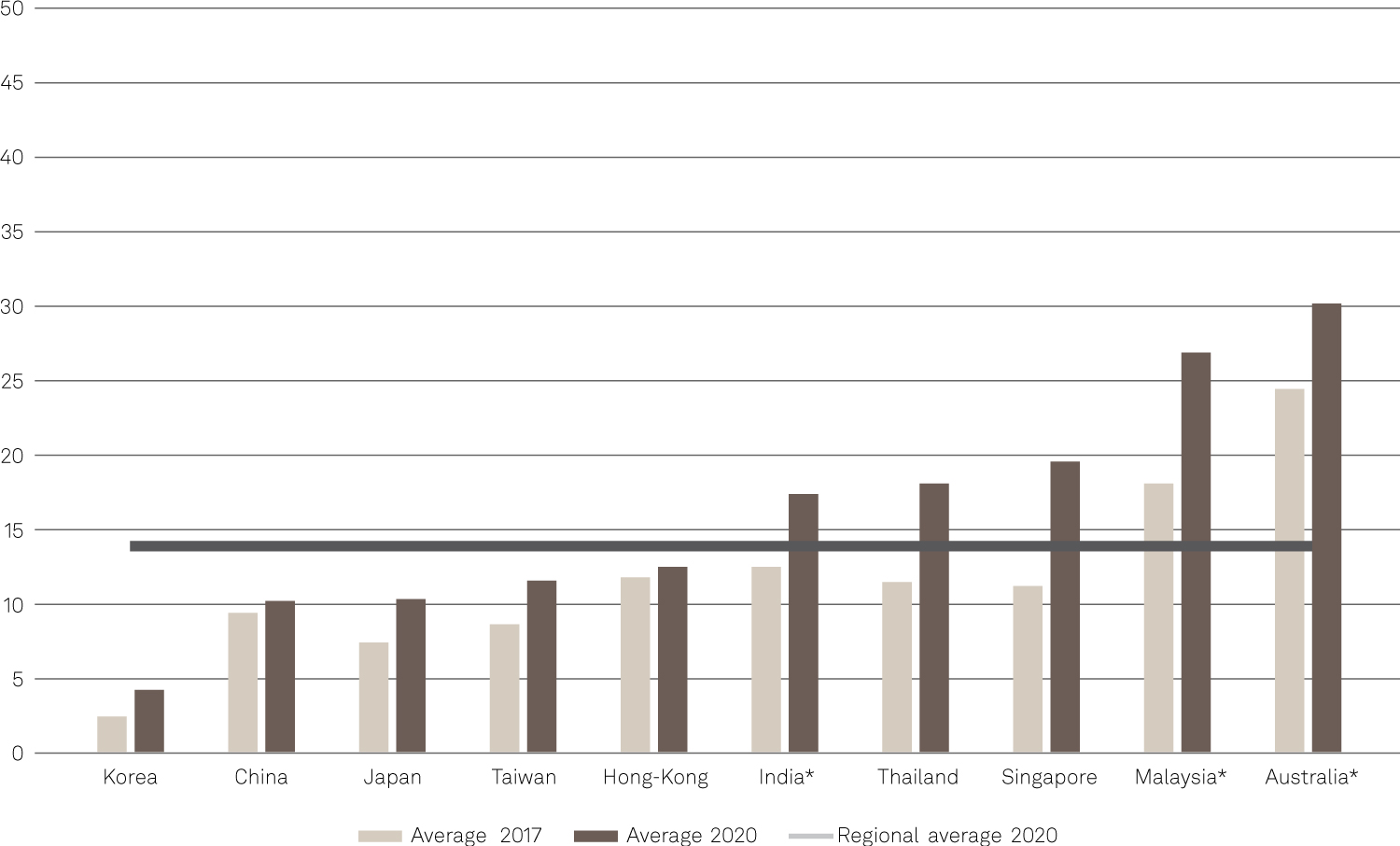
The aforementioned observation tin can be made in the Asia-Pacific region, where companies based in countries with regulations or recommendations in identify performed ameliorate than their regional peers and than the regional average in terms of board gender variety
Asia-Pacific: % of women on the lath
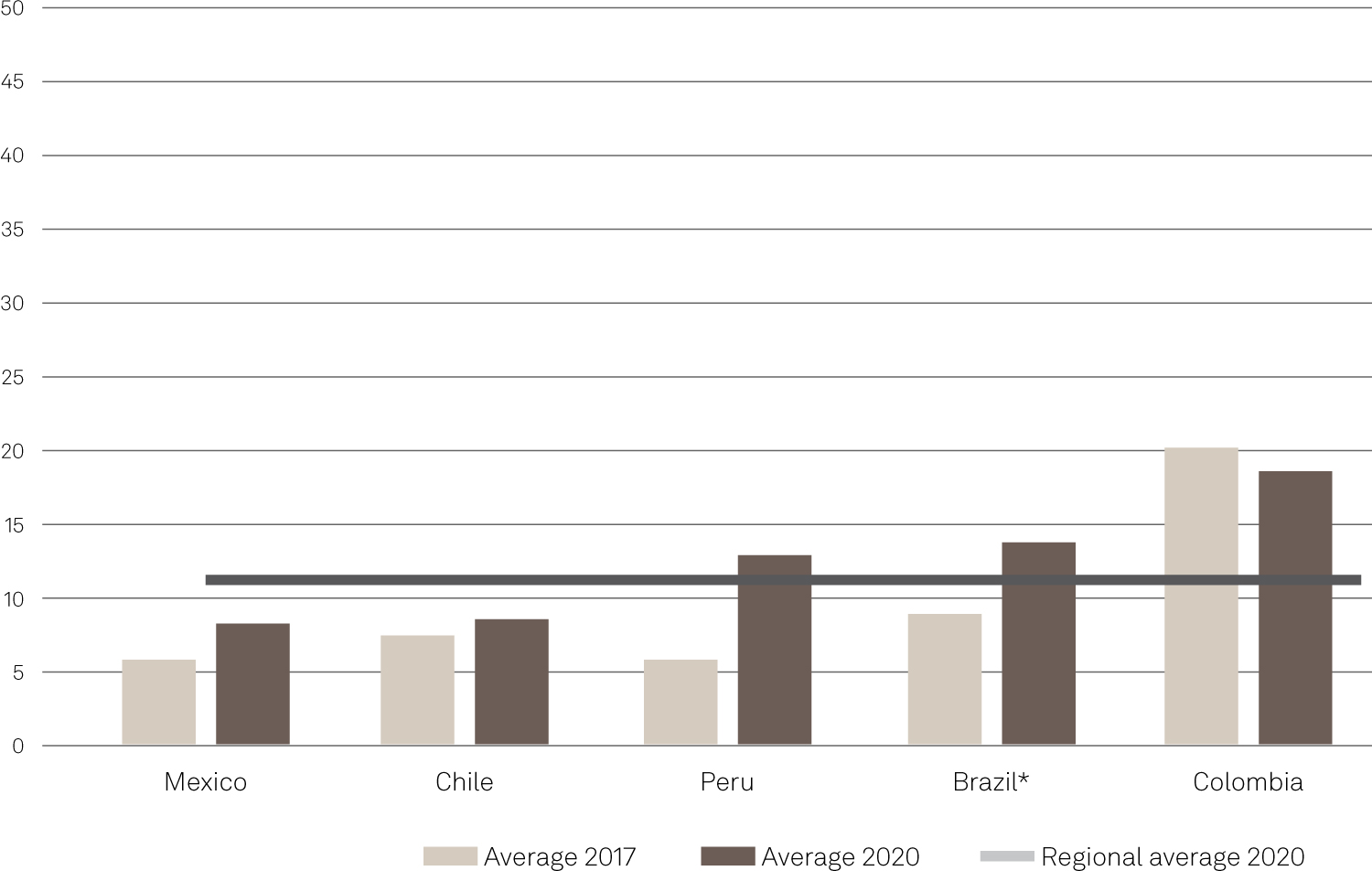
We encounter fewer countries outside of Europe and Asia-Pacific adopting binding or non-binding quotas. Although nosotros observe a general global increase of the percentage of women in boardrooms, Latin America stands out every bit falling behind.
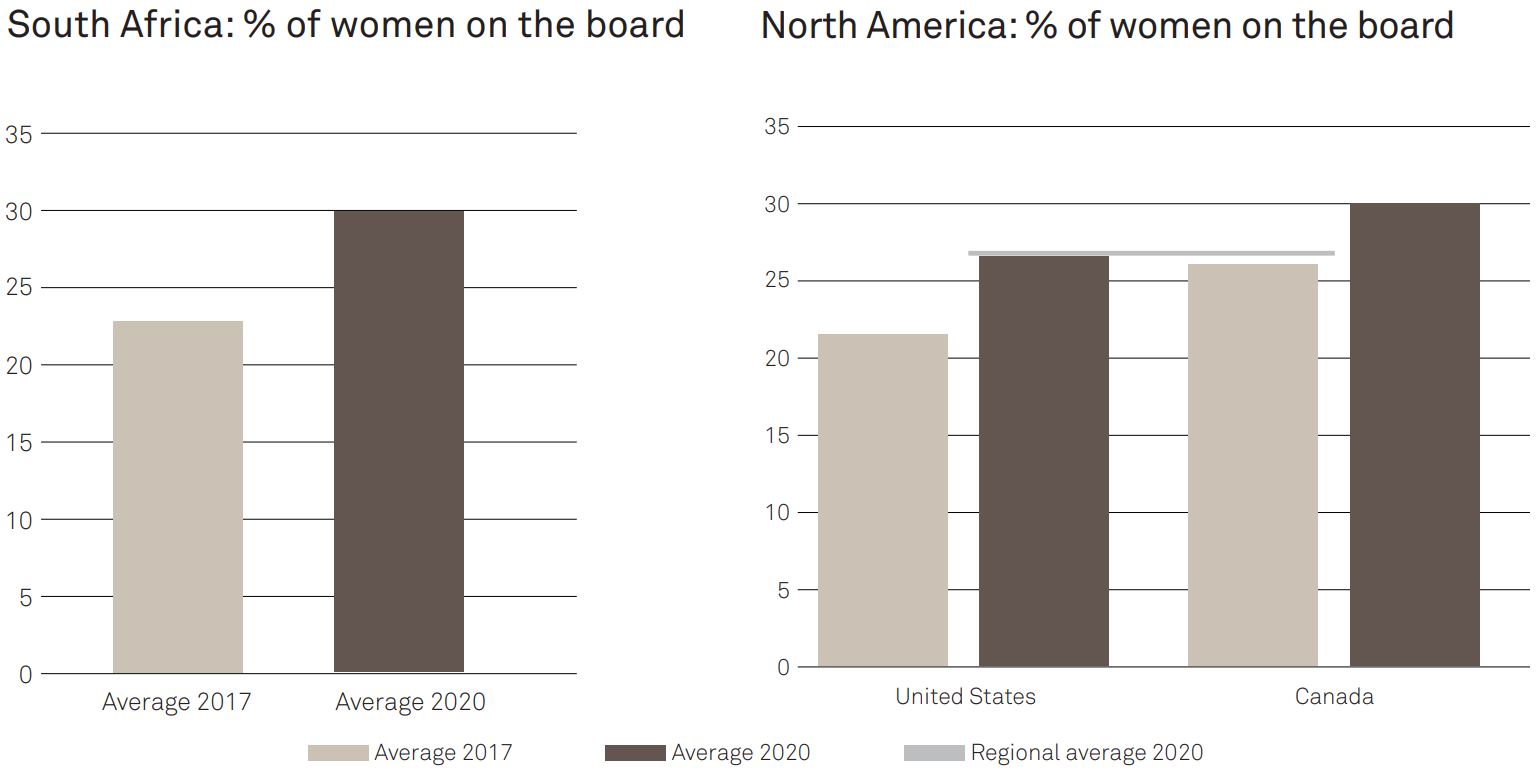
Latin America: % of women on the board
Why focus on women on the board?
The number of women on the board is an easily measurable gender performance indicator, which explains why this is a focal area. Furthermore, it is expected that having more women on the lath will have trickle-down furnishings on the rest of the workforce. For case, it could break down stereotypes on women in leadership and encourage women to pursue their careers further, to seek for roles which they would have not otherwise considered and to ask for more than raises and promotions11. Having more than variety on the board can break down gender barriers by broadening women's "professional imagination", providing them with function models and increasing their capacity to project themselves into leadership roles. College numbers of women on boards can therefore instigate cultural change and has a strong symbolic meaning, showing that women can exist leaders12.
Having more women on the board is also financially material. The McKinsey & Company Diversity Wins Report 202013 found that "companies whose boards are in the summit quartile of gender diversity are 28 percent more than likely than their peers to outperform financially" and the correlations are statistically significant. This might be linked to the fact that more companies accept appointed women directors and in that location is an overall rise in the universe of companies included in the written report, making it more likely to discover statistically significant correlations. However, more than research has been conducted showing that gender diversity in the boardroom matters because information technology brings a broader collection of experience, viewpoints and backgrounds which result in better controllingfourteen. Having more women on the board as well tends to curb excessive risktaking, decrease aggressive taxation strategies and better firm reputation, earnings quality and sustainability operation. These outcomes are not negligible for companies and their shareholders, especially in times of a global pandemic which will require companies to differentiate themselves from their industry peers.
The benefits of diversity apply not just at board level merely throughout companies more broadly, and the question has therefore been raised whether meliorate representation at lath level improves overall diversity metrics of a company.
The impact on other diversity indicators
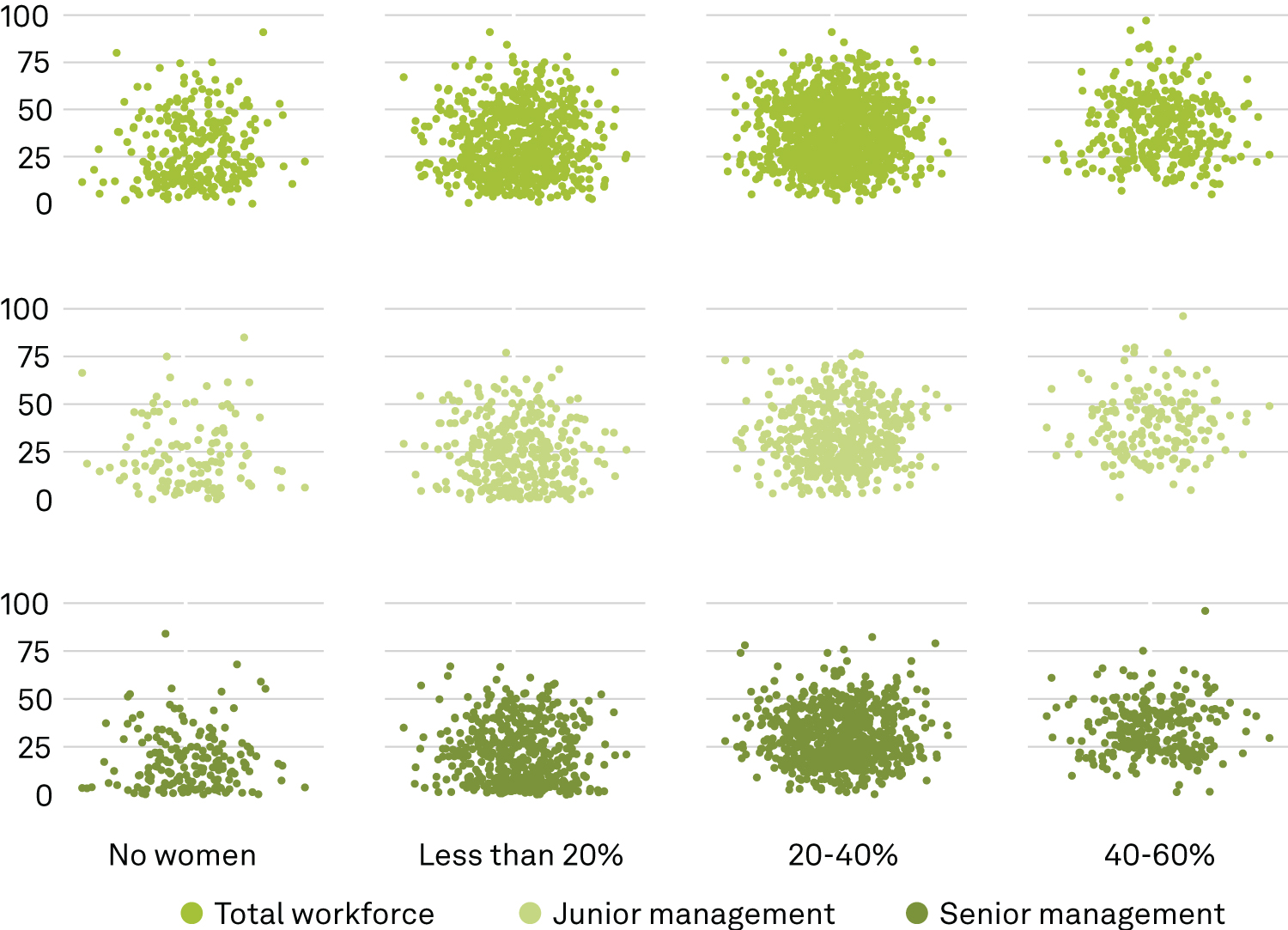
The development of women's "professional person imagination", i.e. their career expectations and aspirations, inside companies with more women on the board is difficult to measure out and grasp through quantitative metrics, at least in the curt term. Furthermore, the expected improvement in diversity metrics such as the percentage of women in leadership and direction roles and the pay ratios has not translated into the information. Indeed, based on the analysis conducted on the data disclosed past companies within the Corporate Sustainability Cess, the correlation betwixt women on the lath and other diversity indicators is depression.
Companies with more women on the board have a slightly college proportion of women on average at dissimilar levels of responsibility. However, it is unclear whether greater board multifariousness drives this trend or whether companies with a more than diverse workforce engage more than women directors. These companies might exist more aware of diversity and gender equality problems, or merely have more women in their talent pool who tin can be appointed as directors. It is therefore unsurprising that companies with more women in the workforce tend to have more women on the lath, and every bit the correlation is not statistically meaning, it is hard to make a potent argument nearly the relationship between both indicators.
Women on board trend and per centum of women by level for year 2020
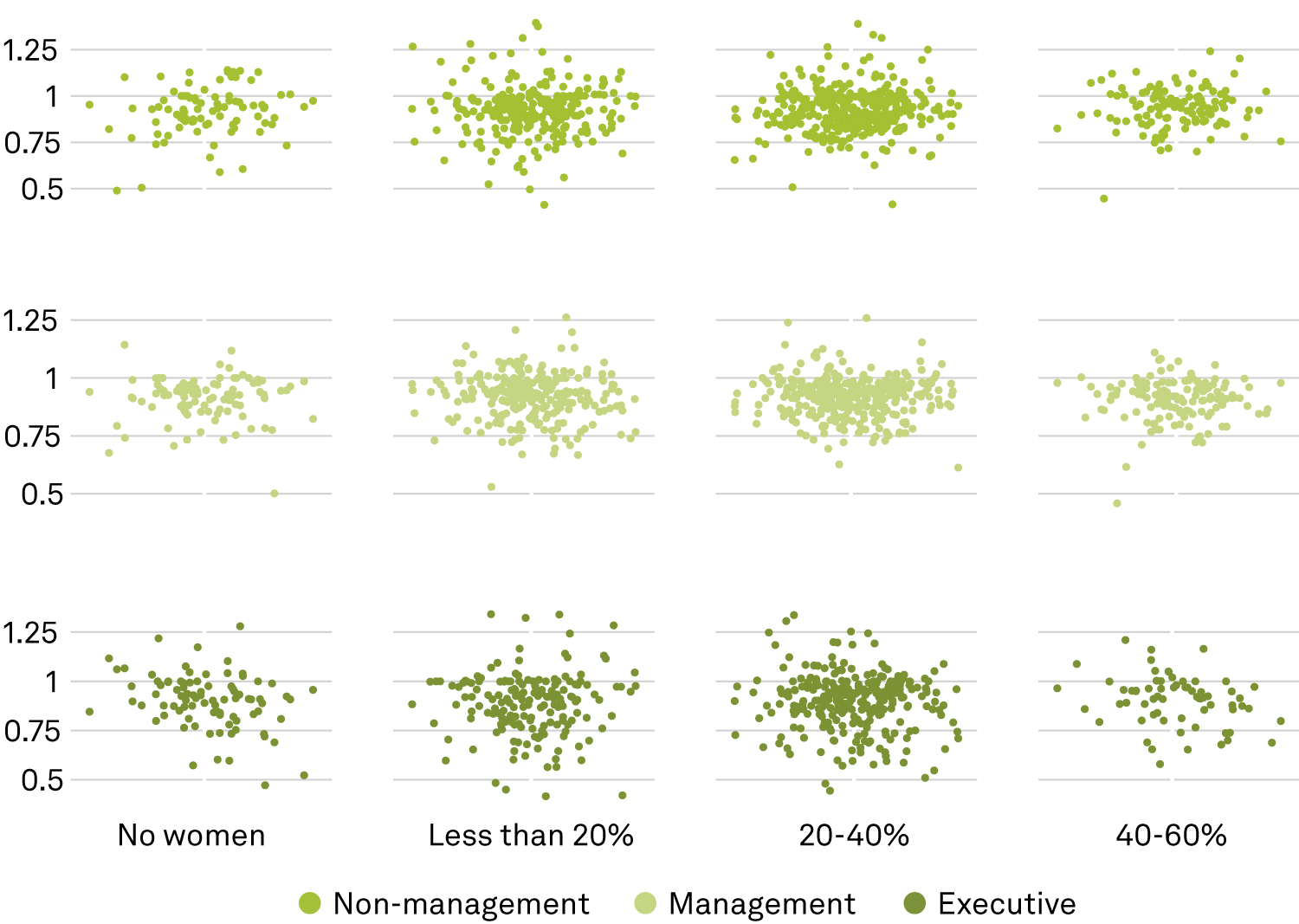
The correlation between women on the board and equal remuneration ratios is even less pronounced. The information collected in 2020 does not show a pregnant relationship betwixt having more women on the board and improved equal remuneration ratios, and the aforementioned assay over the years did not advise any strong correlation between these indicators either.
Women on lath tendency and pay ratio for year 2020
Why don't the benefits trickle down?
Merely focusing on appointing more than women on the board is not plenty to achieve gender equality beyond companies. But why? Several factors are of relevance.
- As women have been facing discrimination in entering the corporate workplace for decades, they tend to take lower levels of experience in the industry, which tin can hinder their legitimacy15.
- Including women as non-executive or independent directors does not necessarily achieve the desired results, because executive members tend to have more say. This is particularly relevant in the context of two-tier boards, where attention should be paid to have gender representation on both boards, and not just on the supervisory boardxvi.
- Women frequently face negative stereotypes in the workplace, which lead them to be perceived as less capable than their male counterparts and therefore to their views not being considered every bit equally important in the conclusion-making process17.
- Simply considering they are women does non mean that they have diversity and inclusion on the top of their agendas.
- While we might find an increasing percentage of women on boards, this does not necessarily hateful that at that place are more women directors overall. In some countries, women simply concord more directorships than men on average, pregnant that we see the same women increasing the board diversity numbers for multiple companies,rather than an increasing number of individual women taking upward these positions18.
Therefore, we cannot rely solely on the pct of women on the lath to measure out a company's gender equality functioning. Looking at the broader representation of women within a company tin provide usa with an opportunity to identify gaps in a more meaningful way.
Moving upwards the ladder
How many steps left?
While the percentage of women on the board has improved over the years in both developed and emerging markets, it stays significantly below the percentage of women in the total workforce, showing that women remain underrepresented in the boardroom. The percentage of women in the total workforce in adult and emerging markets has stayed relatively stable, averaging around 35% over the by 5 years. Nevertheless, the proportion of women decreases as we move upwardly the corporate ladder. Interestingly, in adult markets the percentage of women in senior management is fifty-fifty lower than the per centum of women on the lath. This might hint to the fact that board quotas, by and large implemented in developed markets, have pushed companies to take action on their gender board representation faster than they accept taken action on the representation of women within leadership positions across the company.
% of women at different levels of responsibility in developed and emerging markets
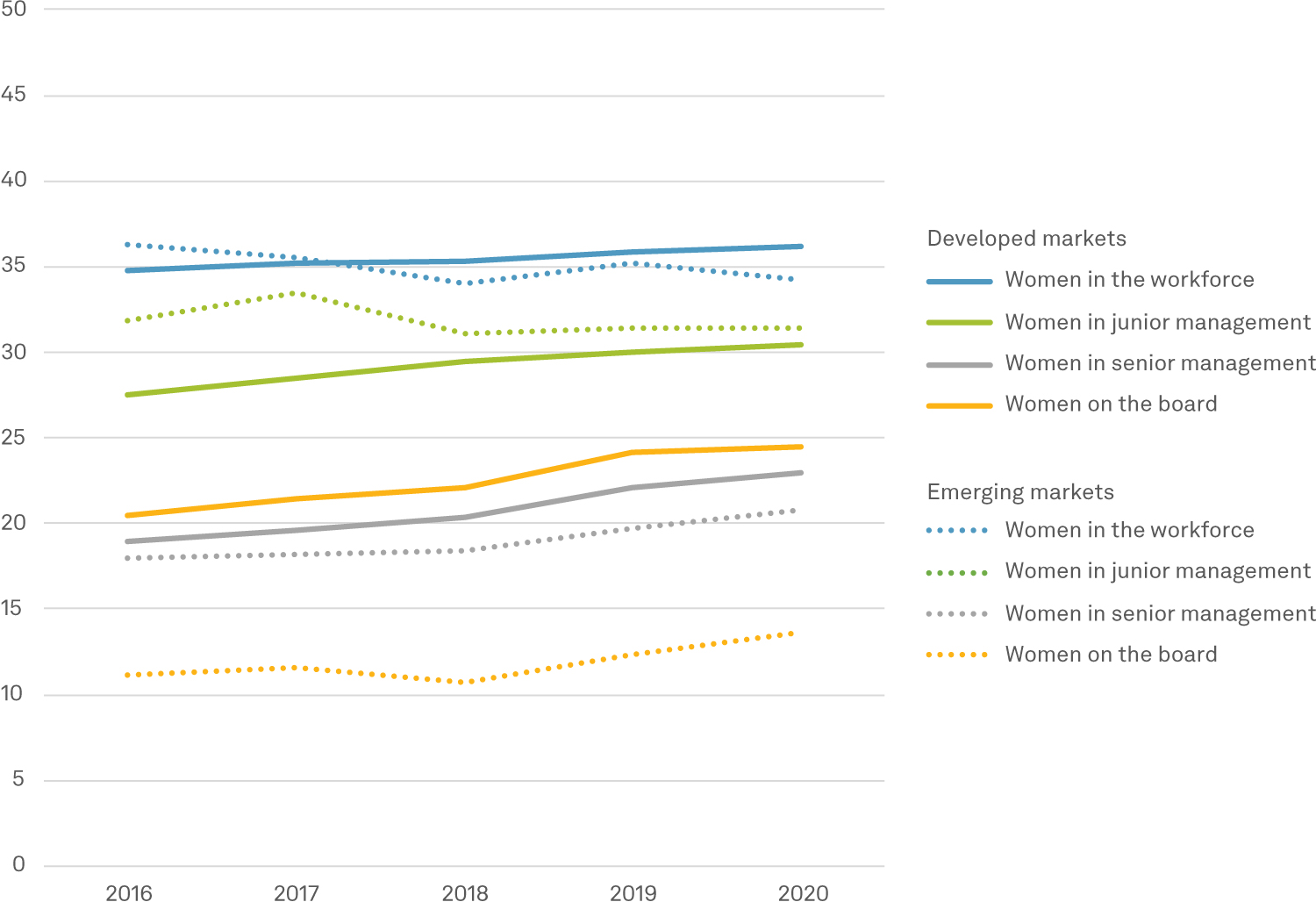
This suggests that companies will take to make more meaning efforts to increase the representation of women, as the approaches taken so far have non led to notable developments over the years. Border Certification, the leading global assessment and business certification for gender equality, with which S&P Global has been collaborating over the years, determines 30% as the critical threshold for a group to achieve substantive representation. Companies will therefore have to adopt targeted strategies to build a more solid span betwixt junior and senior management roles. Investors will also play a role in this transition and can influence this development past moving beyond the board of directors to also focus on the pct of women in leadership positions.
Increasing the number of women in leadership positions is important for lath diversity because information technology broadens the talent pool for lath nominations, and ensures that the women appointed accept the experience, skills and legitimacy required, which every bit mentioned earlier are essential to have a meaningful say in the decision-making procedure. Having more than women in executives positions will therefore make it easier for companies to appoint women directors with the adequate skill set and this could in plough increment these directors' influence on the overall controlling process, potentially improving the trickle-down furnishings on other women in the workforce.
Industry perspective
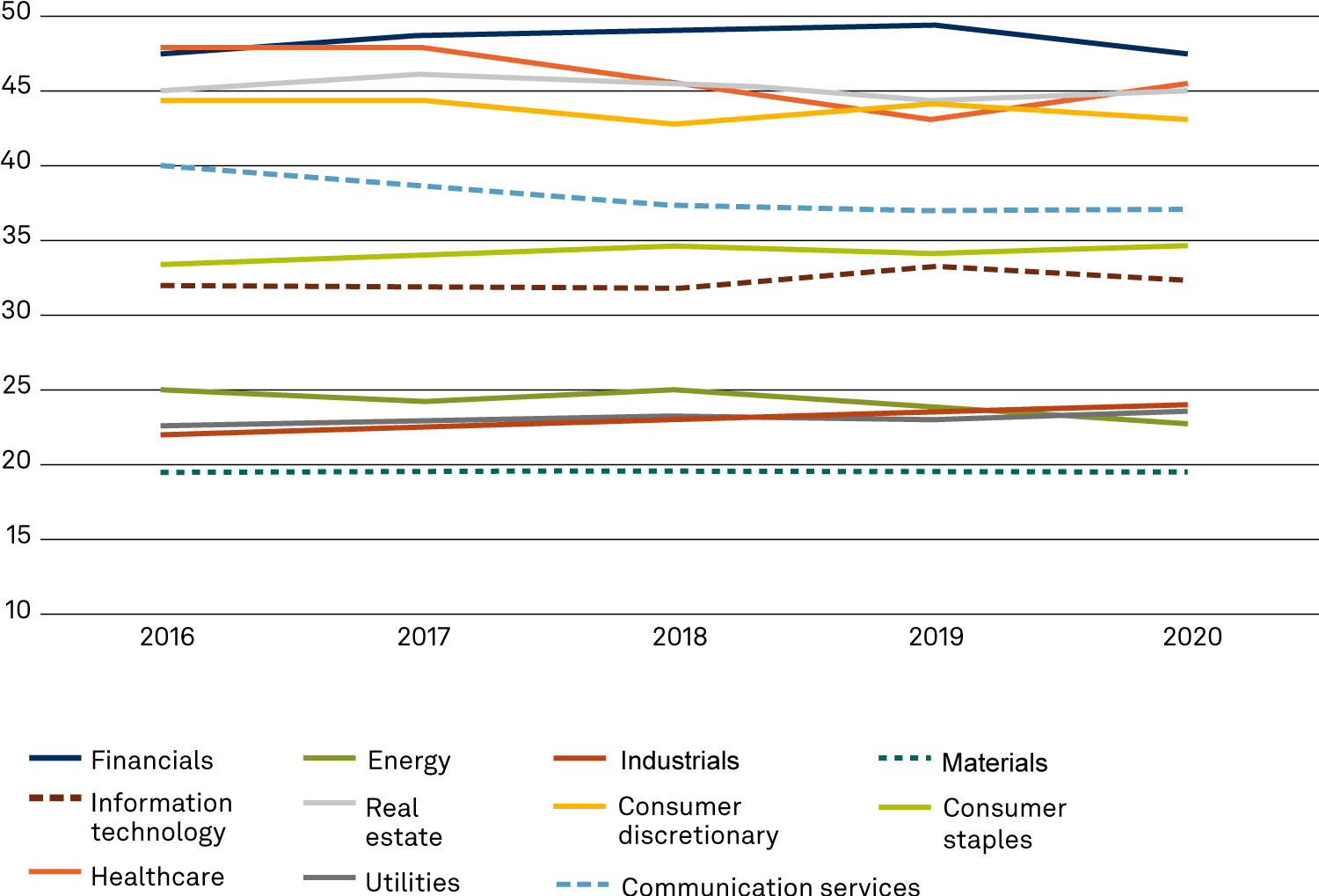
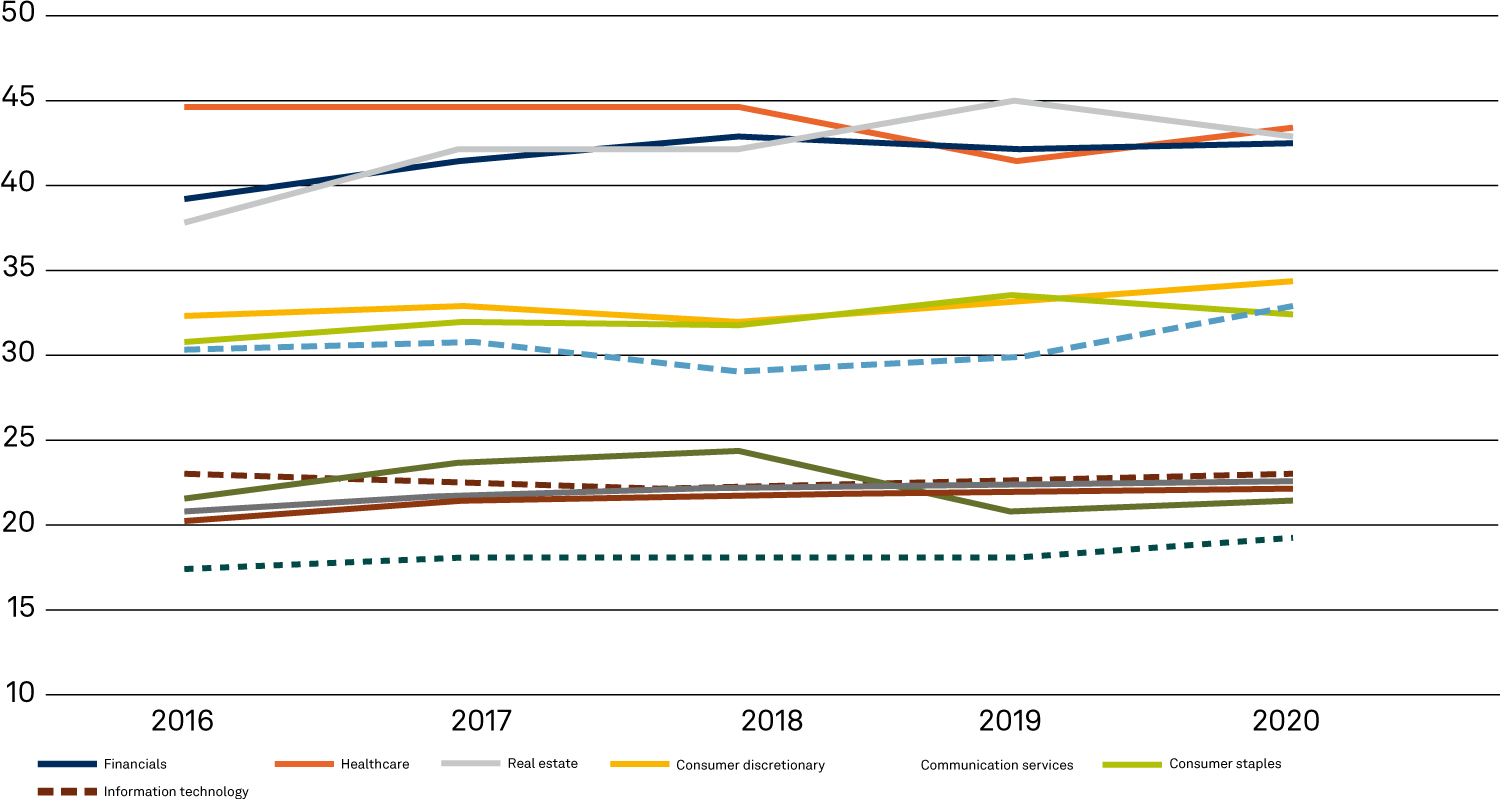
Taking an manufacture-specific approach helps us to identify which sectors are leading positive trends and which ones are lagging behind. As expected, more than client-facing industries tend to accept better representation of women in their workforce and at junior management level. The trends for both indicators have yet stayed alarmingly stable over the past 5 years, and the eleven industry groups more often than not divide into 3 brackets: 20-25%, 30-35% and 40-50%. The all-time performers are the financials, healthcare and real estate sectors, while the laggards lie in the information technology, industrials, utilities, energy and cloth sectors.
Share of women in the total workforce per industry
Share of women in junior management positions per industry
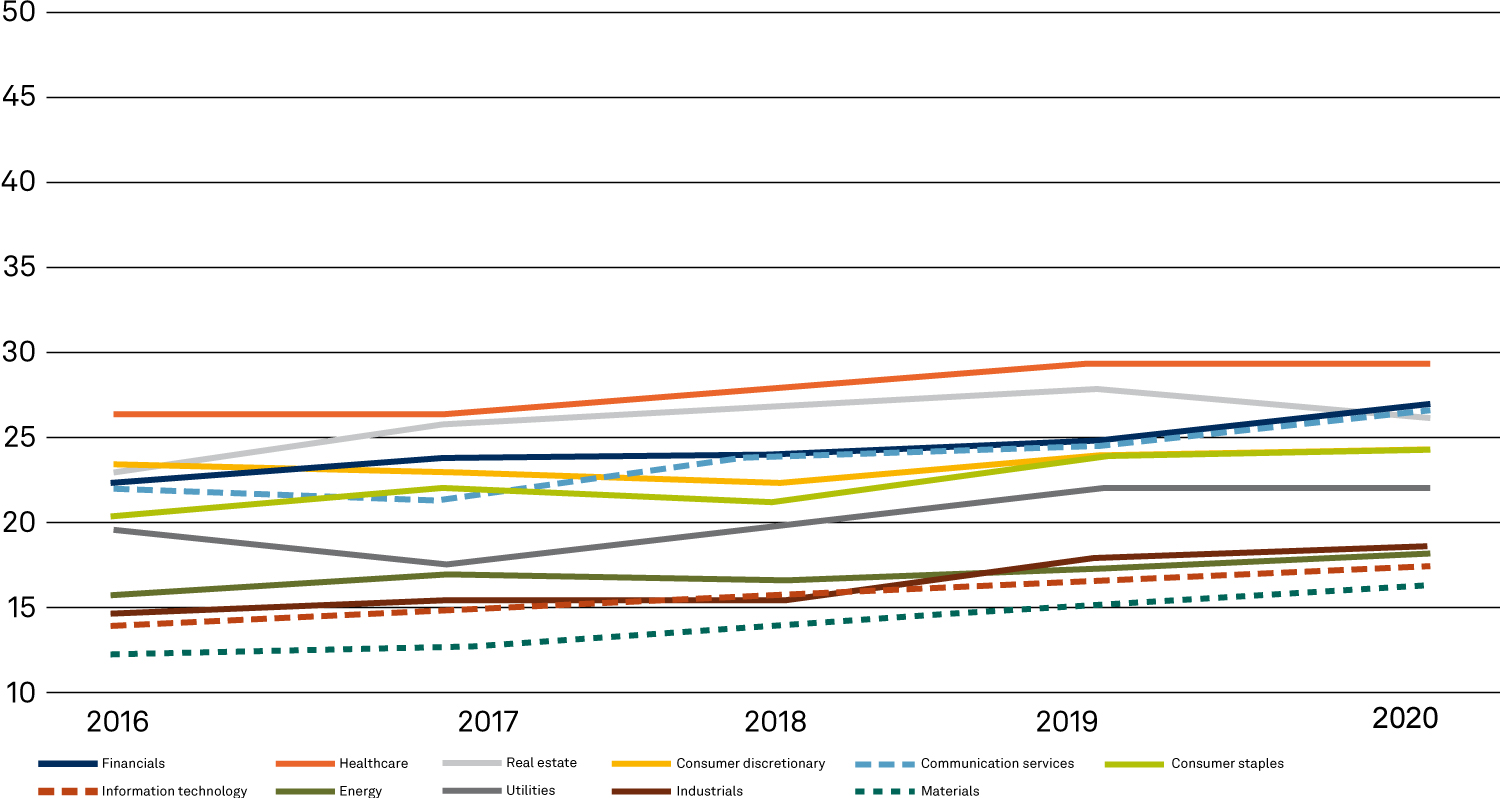
Share of women in senior management per manufacture
Share of women on the board per industry
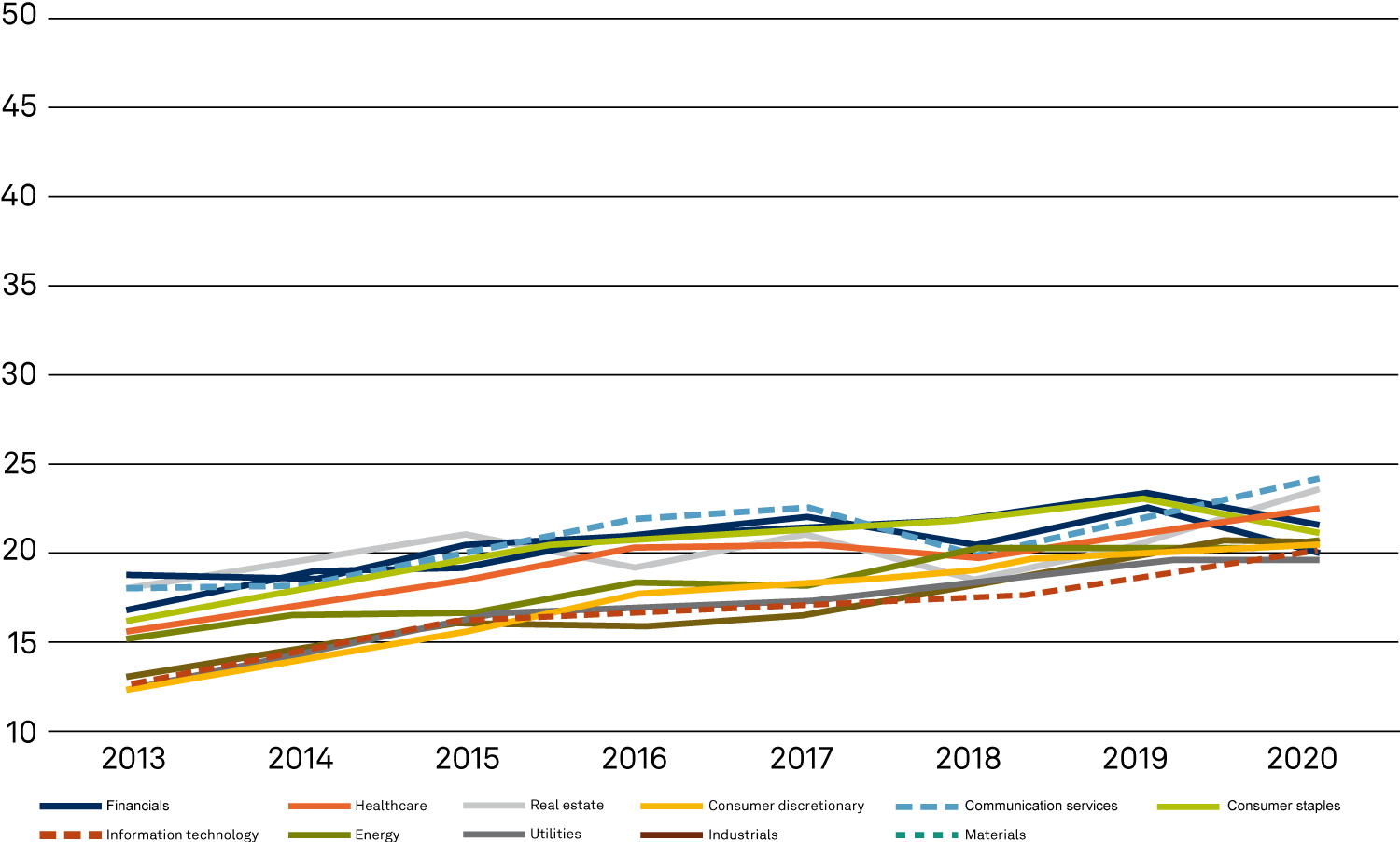
Methodology: The list of sub-industries included in every GICS sector is bachelor at https://www.spglobal.com/spdji/en/documents/methodologies/methodology-gics.pdf
While there is some degree of comparability between the percentages of women in the workforce and in junior management roles, the share of women in senior management positions drops significantly across industries. Nonetheless, the percentage of women in senior management positions has improved over the past few years. This improvement has been ho-hum, with setbacks along the way, merely considering that it takes fourth dimension to build up the skills and experience and to fight through several layers of bias, this trend is encouraging.
Looking at the trends by industry grouping, we run into that although improving, some sectors are all the same far from reaching the thirty% threshold, and at this charge per unit of progress, volition take many more years to get there. This is for case the case for the Information Applied science manufacture, which has gone from 14% to 17% of women in senior direction roles between 2016 and 2020. In this context, the 2020-2025 Eu Gender Equality Strategy's focus on gender issues in artificial intelligence and in the digital transition is extremely important to ensure that women will play a meaningful role in edifice and shaping the digital earth of tomorrow19. Every bit digitalisation will increasingly change our lives and that of future generations, companies and governments accept the responsibility to ensure that all genders, combined with other identity markers such every bit race, historic period, ability, religion, sexuality, are represented in these developments.
How can companies ensure that they retain their women talent and close this gap between the proportion of women in junior management and in senior management? Family-care policies are i avenue to explore, every bit we know that women tend to take on more responsibility and workload in their individual lives. This creates considerable challenges for their career development, when information technology does not lead them to drib out of the workforce completely. Therefore, companies need to focus on improving their work-life residuum policies to ensure gender equality in the workplace. This is especially the example in the face of the Covid-19 pandemic, which has greatly impacted women in the workforce.
Care responsibilities in times of a pandemic
To empathise women'southward advancement in the workforce, it is too necessary to consider flexible working policies and the touch they have on women employees in item. That is especially true now, every bit the coronavirus crisis has acquired a disharmonism of professional person and personal responsibilities, reshaping work and dwelling life worldwide. Women even so bear the burden of childcare responsibilities and home intendance duties in much of the earth. "Gender stereotypes that emphasize the office of women as the primary caregivers and that of men equally the main breadwinners remain deeply ingrained in some regions," the International Labour Organization'south World Employment and Social Outlook Trends 2020 written report plant20.
Working women facing a crisis
During the pandemic, those responsibilities in the habitation have only grown. Many employees transitioned to working from home full- or function-time. Daycare facilities and nursing homes airtight and schooling moved online in many parts of the world, leaving many caregivers with fewer support options during the traditional workday. In a survey of U.Southward. parents and family caregivers that S&P Global conducted in partnership with AARP21, more than one-half of respondents said they are spending more than hours at dwelling taking care of children or caring for adults since the pandemic began.
Unsurprisingly, many parents and family caregivers are experiencing significant increases in stress with the changing piece of work conditions and increased duties in the domicile. Since their commitments have grown, more than 30% of family unit caregivers in the S&P/ AARP survey said they were experiencing a strong increase in stress due to the pandemic'southward implications for their piece of work-life responsibilities. Nearly 43% of all respondents reported a moderate increase in stress. The threat of exhaustion is real and could accept dire consequences for women'south advancement in the workforce in particular. McKinsey's Women in the Workplace 2020 study22 found that more than one in four women are because stepping back in their careers or leaving the workforce entirely — a situation that McKinsey called "an emergency for corporate America." Many of those women are mothers who cite childcare responsibilities as a primary reason for considering downshifting or leaving the workforce. Some companies have responded to the stresses of the pandemic by providing flexible work arrangements, recognizing that a number of employees take establish themselves balancing work with childcare or care for a loved ane during the crisis. Close to 37% of respondents to the Due south&P Global/AARP survey said their companies have added flexible work hours to their policies since the pandemic began. In some instances, employers accept moved speedily to conform their policies for working parents. Tech giant Microsoft23, for case, recently began offering a new "pandemic school closure" and childcare leave benefit that gives parents equally many as 12 weeks of paid leave to care for their children at home. Other firms have provided employees with ad-hoc days off to let them to recharge.
Women on the board and well-existence policies
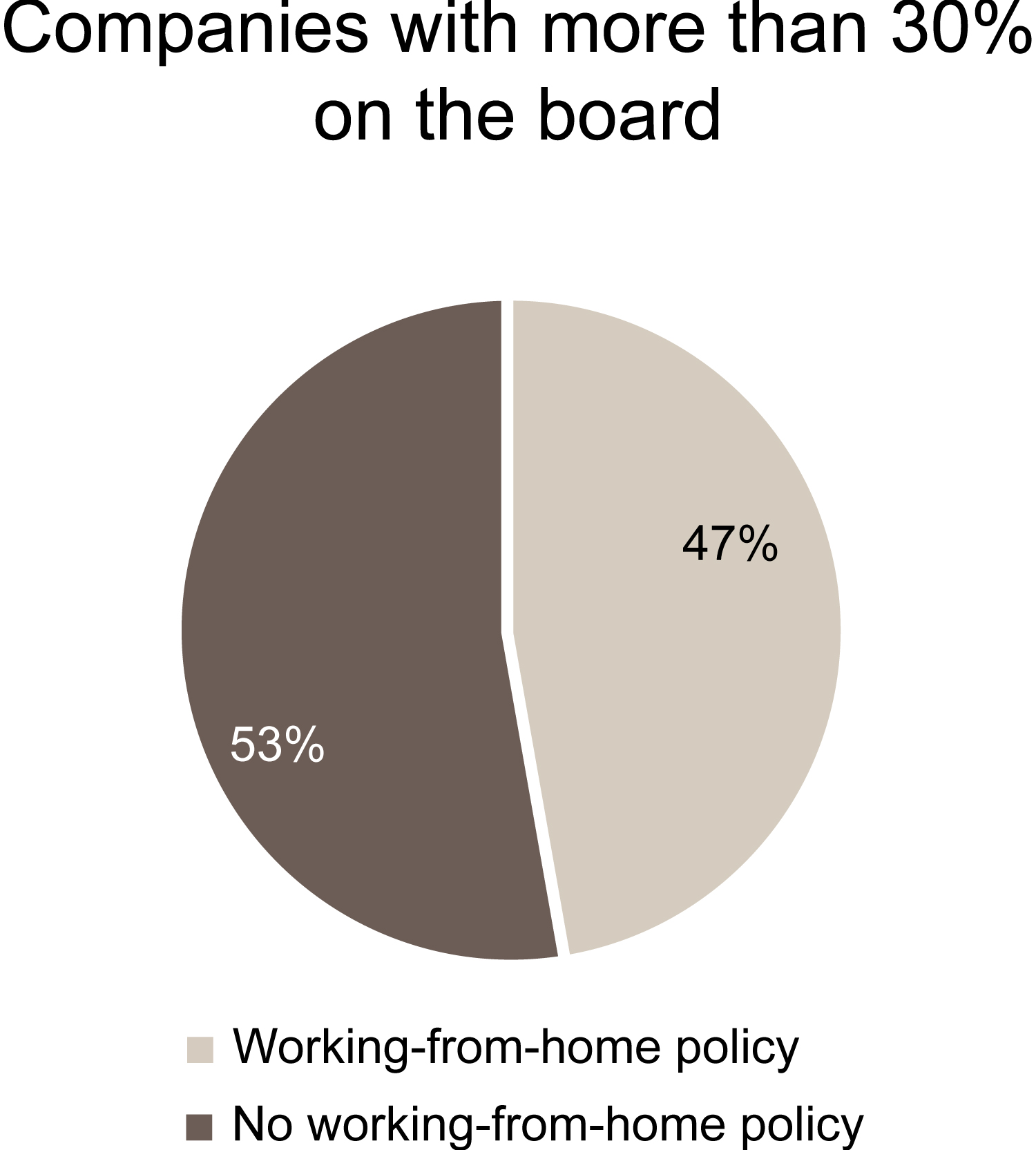
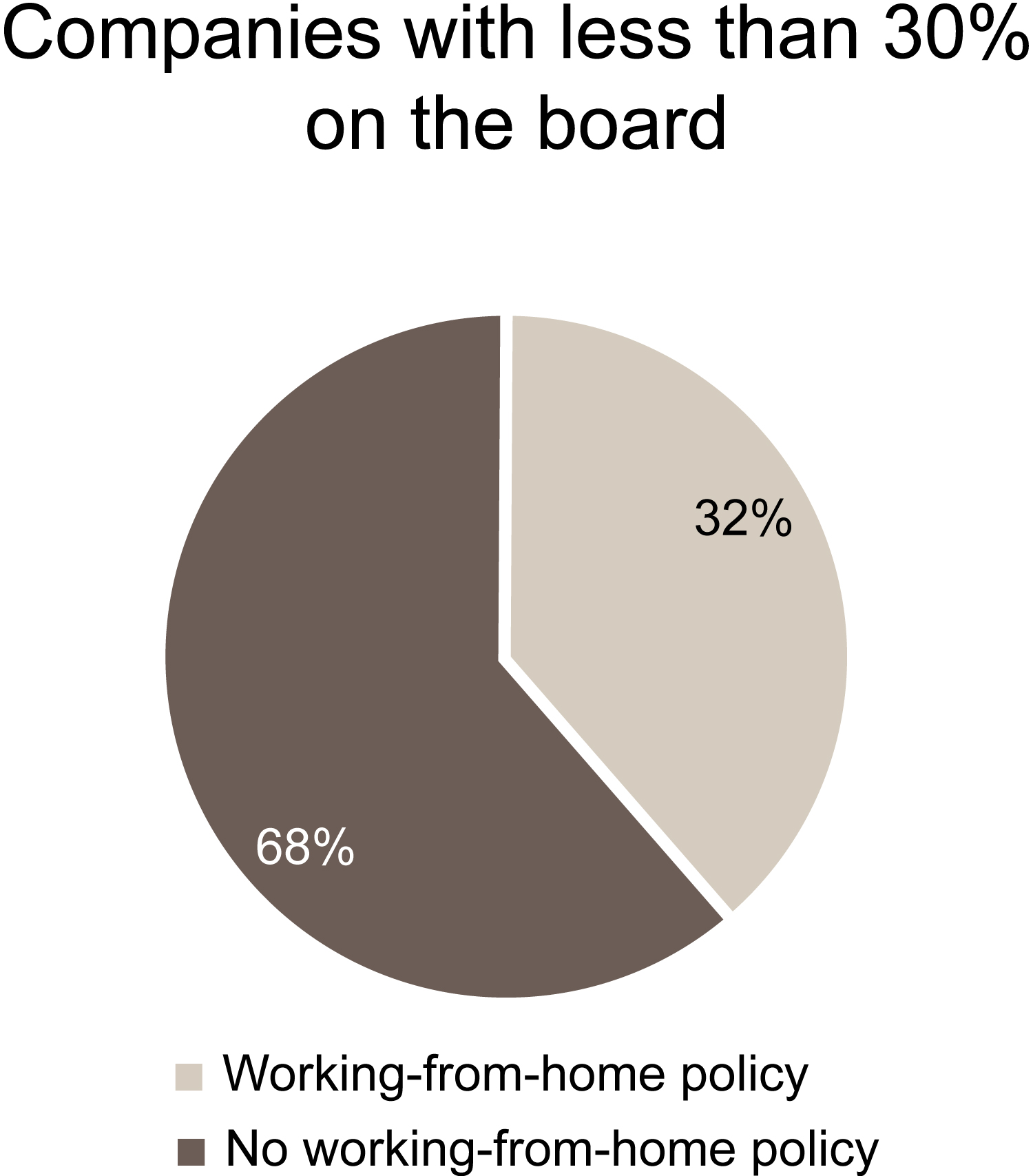
Globally, CSA data shows a positive correlation between women being represented on the board and the existence of work-from-abode options and flexible working arrangements. Merely a 3rd of companies with a low representation of women on the board — defined here equally less than 30% — offer piece of work-from-home options. Simply nigh one-half of companies with more than thirty% of women on the board offer some form of remote-work pick.
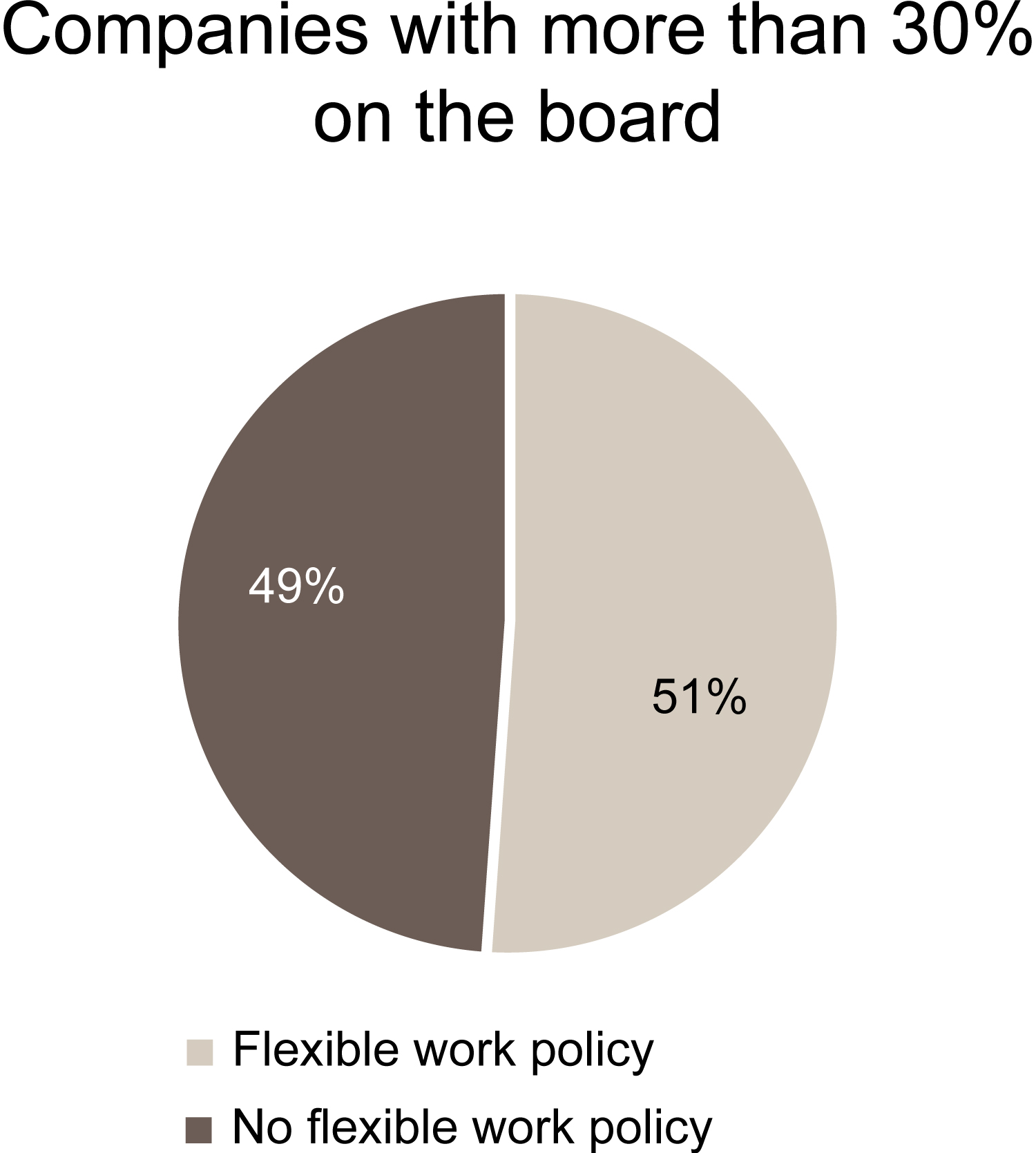
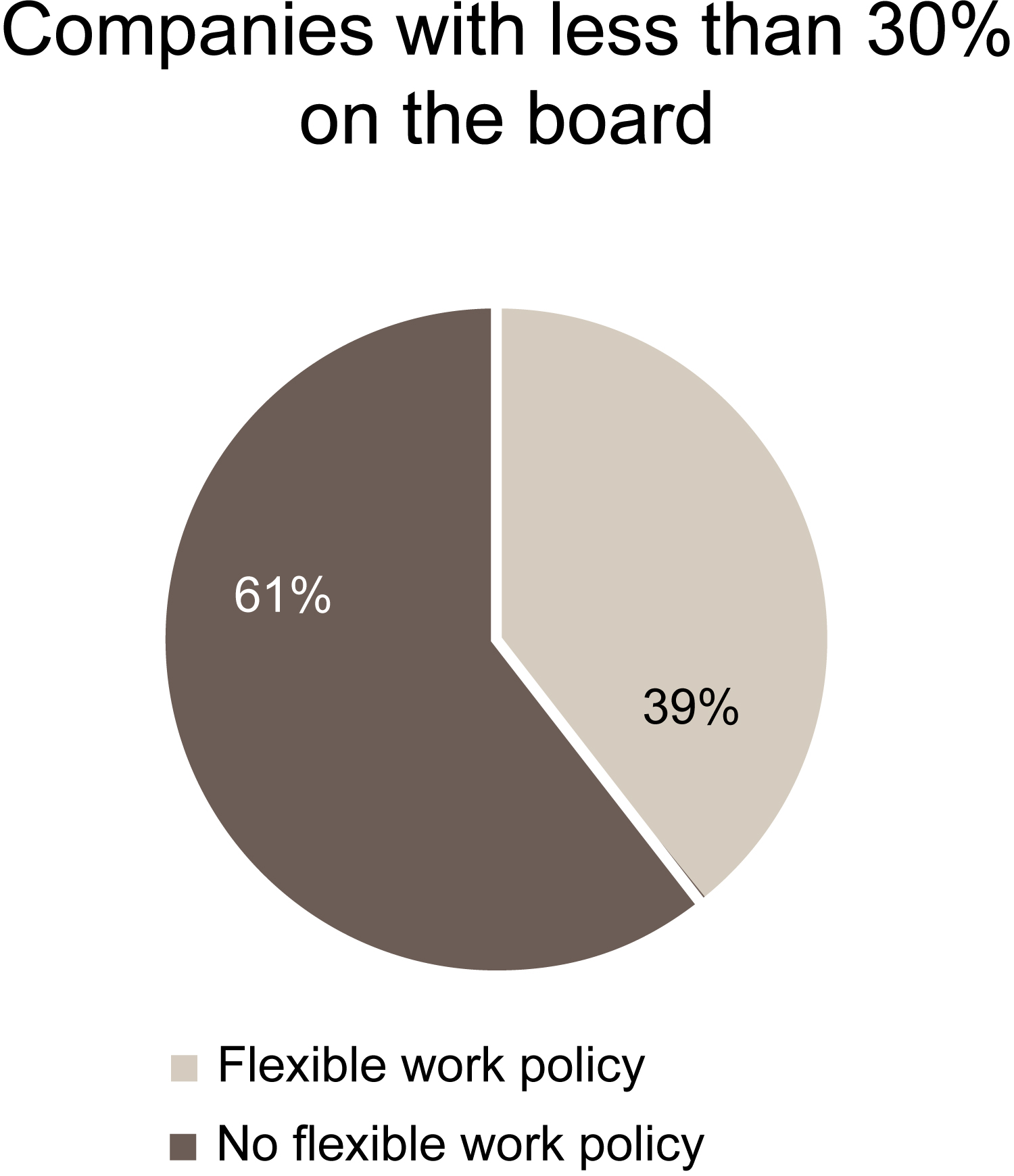
Similarly, companies with greater gender board diversity appear more than probable to offer flexible working arrangements. Merely 39% of companies with low proportions of women on the board offer flexible working arrangements, compared to 51% of companies with high proportions of women on the board. According to another analysis also integrating data from Equileap, a provider of gender-equality data and insights, greater representation of women on the lath and in executive positions tends to be associated with flexible hours offered to employees.
The benefits of flexibility
Flexibility can exist an effective tool in recruiting and retaining women. South&P Global and AARP analyzed information from Equileap and constitute that 319 companies of the i,389 in its sample offer flexible hours and ensure equal recruitment policies. Companies with equal recruitment strategies commit to ensure non-bigotry against whatever type of demographic grouping and equal opportunities to ensure gender parity. The enquiry establish that companies with equal recruitment policies and flexible hours tend to recruit more than women.
Flexible work arrangements also appear to aid with memory of employees. The inquiry establish that companies that offer flexible hours tend to come across lower voluntary and total turnover rates, and the correlation was statistically significant. Turnover is also lower when companies have flexible location options, according to our analysis of data from Equileap and S&P Global'southward CSA, and the correlation was statistically pregnant.
Women are more probable to use flexible work arrangements and in detail function-time work to balance their work and family commitments, co-ordinate to an October 2020 report on flexible working from Gapsquare24, a enquiry firm that uses equality and variety data to analyze pay disparities. Gapquare'south research institute that in the face of COVID-nineteen, flexible working is at present seen every bit "essential for any employee, instead of inherently gendered."
However, "this does not mean that the gender attribute has been erased — mothers spend more than time on domestic responsibilities than fathers during the lockdown," GapSquare wrote. Withal, the firm suggested the pandemic could mark the beginning of "real, long-term modify." If men were able to and made use of flexible hours and locations policies to take on more domestic and care responsibilities, women in the workforce would benefit greatly.
Long-term impacts of the pandemic
While the pandemic has greatly accelerated the discussion around more family-friendly policies, fears that current conditions will become permanent and significantly fix back women'south participation and advancement in the workforce are crystalizing. The pandemic has increased the time required to meet family responsibilities and has brought more stress for many workers. As the investor community puts increasing emphasis on sustainability issues in general and treatment of employees in item, companies cannot beget to ignore this event.
The gender pay gap could as well contribute to pushing women out of the workforce among the pandemic. In the U.South., for example, American women earned about 81% of what men earned in 2018, according to the country's Bureau of Labor Statistics25. "Because there is a gender pay gap, so often in a couple situation, the i with the higher-paying job is going to stay working. And information technology's the women that are going to pull dorsum, become to part-time, or stop working completely," according to Natasha Lamb, Managing Partner and Director of Equity Research & Shareholder Appointment at Arjuna Capital, a sustainableinvestment house she co-owns. When asked in an interview with Due south&P Global26 how the pandemic will affect women's advancement in the workforce and progress toward closing the gender pay gap, she was blunt: "I think it'southward going to be a disaster." Taking this risk into account, companies can determine to human activity now in club to decrease the probability and adverse effects of losing their women talent.
In combination with family friendly policies, other practices can have a great bear on on a company's gender residuum. Proactive management of pay equity, including conducting regular gender pay gap assessments, systematically eliminating identified gender pay gaps and communicating on these practices are primal steps towards gender equality. Creating gender diverse recruitment teams and ensuring diverse candidate pools, as well as setting targets and objectives for the gender composition of direction levels, are further practices that companies should adopt in society to improve their gender equality functioning and counteract the potential setbacks acquired by the pandemic.
Where are nosotros going?
A key take-away from this article is that while increasing the proportion of women on the lath is important, farther steps are needed to improve gender equality in the workforce. Companies demand to hire and promote more women into senior management positions. This presents opportunities for companies to access new talent pools and increase innovation and efficiency, as we know that diverse teams perform better. Having more than women in senior direction will in turn ensure that they take the adequate skill sets and required experience to exist appointed every bit board members, enabling companies to reach their quotas and align with the increasing number of regulations around the percentage of women on corporate boards. Investing in women talent early therefore diminishes regulatory risks downwards the line. Having more women in leadership volition too diminish the biases and negative stereotypes effectually women'due south ability to lead, hopefully addressing issues around unequal pay and gender pay gaps. Considering the growing regulatory frameworks and transparency expectations around remuneration practices, companies tackling these issues now will profit from lower compliance costs in the future. Furthermore, fair representation and compensation practices atomic number 82 to better employee engagement, talent attraction and retention, and efficiency. The operational opportunities of gender equality in the workforce will therefore enable companies to differentiate themselves from their peers in a competitive environment.
Shareholders have their part to play in this shift, as they can push companies to adopt ameliorate practices and better their functioning in terms of gender equality. They can act faster than governments by imposing their ain quotas. This does not but ensure that their investment practices align with the United nations Sustainable Development Goals, especially goal number 5 on gender equality, just also increases their opportunities for better returns, equally gender-equal companies face lower regulatory and operational risks. Drawing from this inquiry, investors tin at present adjust their focus to reflect the importance of multifariousness indicators across the percentage of women on the lath.
Diversity also needs to expand its telescopic to move away from addressing women equally one group and to instead recognise the heterogeneity of women's experiences in the workplace. More efforts need to be fabricated to collect data on indicators such as race, ethnicity, caste, religion, disability, sexual orientation and other identity markers, in society to accost the farther inequalities that some women feel according to their intersecting identities. Somewhen, the discourse should also shift to recognise women for their abilities, experience and skills rather than branding them every bit variety trophies. Companies and investors can assistance the globe to wake up to the possibility that women deserve a say in the decisionmaking process equally legitimate leaders and fully-entitled human beings.
1 Earth Economical Forum (2020), Global Gender Gap Written report 2020.
two Taub, A. (26 September 2020) Pandemic Will 'Take Our Women 10 Years Back' in the Workplace. The New York Times.
three Mahajan, D.; White, O.; Madgavkar, A. & Krishnan, M. (16 September 2020) Don't Allow the Pandemic Set Back Gender Equality. Harvard Business Review.
4 Smucker, 1000. (24 June 2019) How Are Gender Lens Funds Performing? CFA Institute.
v White, L. & Dholakia, One thousand. (17 September 2018). Ranks of US gender-various boards grow, simply less than 25% of directors are women. S&P Global.
six Lemosof, M. (29 November 2019). La Fox lance le fonds Valeurs Féminines Global. Gestion de Fortunes.
7 Catalyst (15 January 2020). Pyramid: Women in S&P 500 Companies.
8 Smucker, M. (26 May 2020). Gender Lens Investing: Where to from Here? CFA Institute.
9 Equileap (2019). Gender Equality in Kenya: Assessing 60 leading companies on workplace equality.
10 European Commission (2020). A Union of Equality: Gender Equality Strategy 2020-2025.
11 Deloitte (2019). Data-driven modify: Women in the boardroom – A global perspective. Global Eye for Corporate Governance, 6th Edition.
12 Kowalewska, H. (2020) Bringing Women on Board: The Social Policy Implications of Gender Diversity in Tiptop Jobs. Journal of Social Policy, 49 (4).
13 McKinsey & Company (2020). Diversity wins: How inclusion matters.
xiv Zukis, B. (thirty June 2020) How Women Will Salvage The Futurity, One Corporate Board At A Time. Forbes
15 Smith, Northward. (2018) Gender quotas on boards of directors. IZA Globe of Labor.
16 Kowalewska, H. (2020) Bringing Women on Board: The Social Policy Implications of Gender Diversity in Tiptop Jobs. Journal of Social Policy, 49 (iv).
17 McKinsey & Company (2017). Women Matter: Time to accelerate. 10 years of insight into gender diversity.
18 Adams, R. B. (2015) Myths and Facts virtually Female Directors. IFC Corporate Governance Knowledge Publication 37
xix European Commission (2020). A Matrimony of Equality: Gender Equality Strategy 2020- 2025.
20 International Labour System (2020). World Employment and Social Outlook: Trends 2020..
21 Stovall, Due north.; Nematzadeh, A.; White, 50. & Skufca, L. (2020). Something'southward Gotta Requite: COVID-xix Could Chop-chop Expand FamilyLeave Policies; It Could Also Deal A Serious Accident To Women In The Workforce. S&P Global.
22 McKinsey & Company (2020). Women in the Workplace 2020.
23 Stovall, North.; Nematzadeh, A.; White, L. & Skufca, L. (2020). Something's Gotta Requite: COVID-19 Could Rapidly Expand FamilyLeave Policies; It Could Also Deal A Serious Accident To Women In The Workforce. South&P Global.
24 Gapsquare (2020). Report not publicly available.
25 TED: The Economics Daily (22 March 2019). Women's had higher median earnings than men in relatively few occupations in 2018. U.South. Bureau of Labor Statistics.
26 Stovall, N.; Nematzadeh, A.; White, L. & Skufca, L. (2020). Something's Gotta Requite: COVID-xix Could Speedily Expand FamilyLeave Policies; It Could As well Bargain A Serious Blow To Women In The Workforce. S&P Global.
Source: https://www.spglobal.com/esg/csa/yearbook/articles/gender-equality-workplace-going-beyond-women-on-the-board
Posted by: felixforridgen.blogspot.com
0 Response to "How Did The Women's Movement Change The Gender Makeup Of The Workforce?"
Post a Comment