

How To Choose Colors For Drawing

Color trends are getting wacky.
Gradients everywhere, companies rebranding with bold, bright colors at every plough…it'south a lot to take in. If you've been living under a rock and have no thought what I'm talking about, have a look at our analysis of the pinnacle graphic design trends for 2022 .
How can you perchance keep upward?
Well, I'd like to throw an even crazier idea out there: creating compelling color schemes for infographics is not all about following the hottest trends .
Yes, you should definitely consider what's trending when thinking almost color. But if you lot're not a full-time designer, y'all'll probably struggle to make most of those trends piece of work for yous.
My advice: focus less on mode, and more than on substance.
Researchers spend a lot of time investigating the perception and cognition of color, and we can use what they larn to design better, more than effective graphics.
Lookout: Everything you need to know most COLOR… in nether 3 minutes!
A flake well-nigh color theory
Nosotros tin't talk over colour without a fleck of bones color theory. I'll keep it to a bare minimum, I promise.
Come across the color wheel:

If you're annihilation like me, you're flashing back to elementary school fine art form right about now. Believe information technology or not, the colour wheel is actually a very useful tool when it comes to design. It can assistance u.s. sympathize color relationships, which are indispensable for visual advice.
I'm certain you know that the principal colors (crimson, xanthous, and blueish) mix to grade the secondary colors (orange, green, and royal).
Accept it a stride further, and you'll encounter that the secondary colors mix to form the tertiary colors (vermillion, bister, chartreuse, teal, violet, and magenta), rounding out the color wheel.

How can nosotros use this color wheel to create impactful color palettes? Let'due south start by reviewing the classic colour relationships.

- Monochromatic: A monochromatic colour scheme consists of a single color (or multiple variants of that color).
- Coordinating: Analogous colors are side-by-side on the color cycle.
- Complementary: Complementary colors are across from each other on the color wheel.
- Split-complementary: A split-complementary color scheme is a variant of the complementary color scheme, with one base colour and two secondary colors adjacent to its complementary color.
- Triadic: A triadic color scheme features 3 equidistant colors.
- Tetradic: A tetradic color scheme features two pairs of complementary colors.
That's all you lot need to know for at present. I'll be using these terms afterwards, so feel free to refer back hither to refresh your retentivity.
Harnessing the power of color for communication
Graphic designers use all sorts of tricks to enhance visual communication. When it comes to communication, colour is ane of the about powerful tools in the designer'south toolkit.
Color is peculiarly useful for:
- Creating contrast
- Grouping elements
- Encoding quantity
Let's take a expect at each of these in turn.
ane. Use color contrast to brand your most relevant content visually salient
Salience is a quality that makes an object stand out against its surroundings. Similar a loud phone ringing in a quiet room, or the flash of some (terrifying) creature's eyes on a dark evening, salient objects or events immediately take hold of our attending.
We can acquire to control salience in our infographics to help our viewers pay attention to the most important elements of a composition. By playing with attributes like colour, shape, size, position, and orientation we tin can create the dissimilarity that our encephalon is hardwired to pay attention to.
Let's do a lilliputian exam.
How long does it take yous to notice the odd i out in this image?

How near this 1?

And this 1?

In the first example, we accept to do a flake of work to pick out the unique shape. In the second, the larger circumvolve jumps out pretty quickly. In the last example, we barely have to glance at the image to know that the odd one out is the far-right circumvolve in the central row.
Colour is by far the most powerful visual quality when it comes to creating visual salience through contrast.
How do we tin utilise this to infographics?
2. Add a unmarried highlight color to a blackness and white composition
Hither's a Venngage electronic mail newsletter template aimed at sharing monthly revenue results with employees. I've fabricated this first example black and white to remove whatsoever of the visual salience gained from color data:
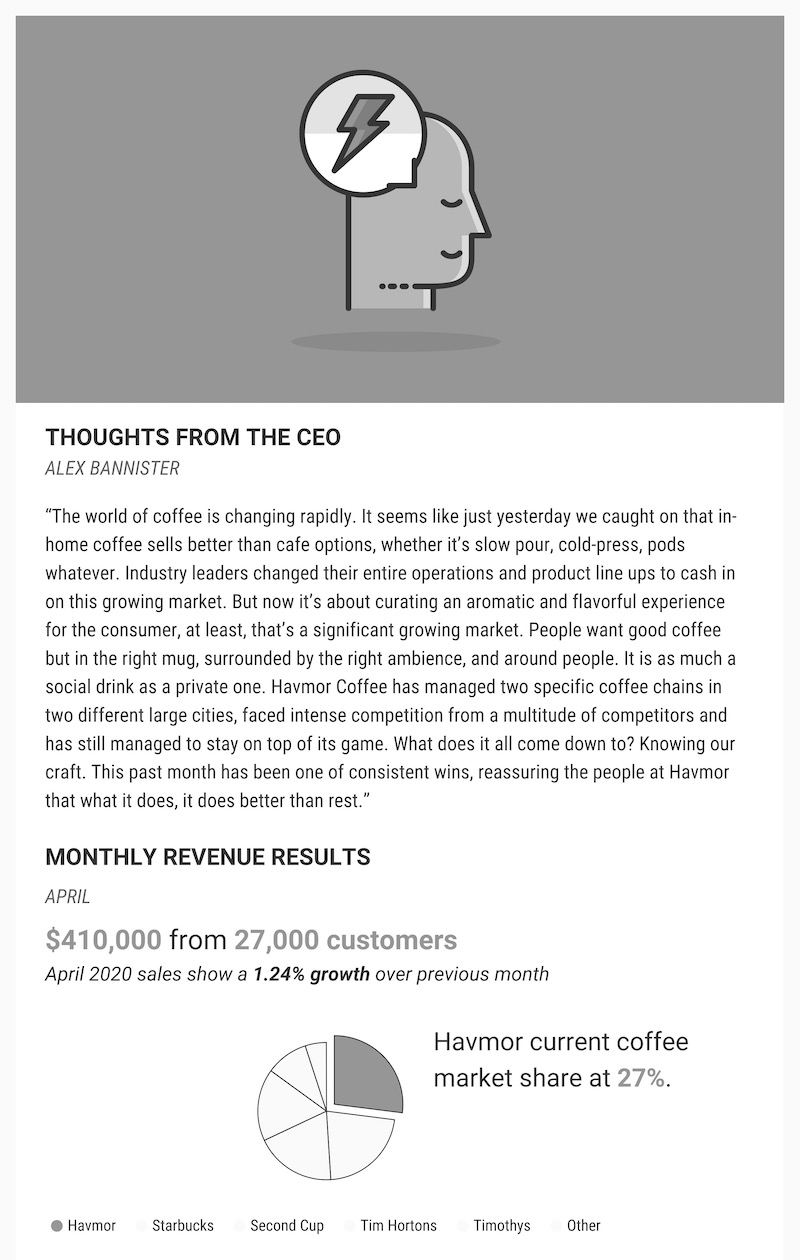
When I glance at this, I immediately see the banner image at the top and the highlighted chunk of the pie chart at the lesser, because they're particularly dark. But the about of import information hither (the revenue, client base, and market share) doesn't stand up out.
Realistically, we only have a few seconds to catch our readers' attention before they send our email hurtling towards the trash. Using colour to highlight the central bits of data, we tin capture our readers in a fraction of that fourth dimension:

With a single colour strategically creating some visual salience, we've dramatically improved our chances of engaging with our readers.
When working with black and white compositions, adding a highlight color is fairly straightforward. Allow'south see if we can apply what we know about colour theory to apply the same principles to more than complex situations.
3. Apply black and white to add contrast to monochromatic compositions
Monochromatic color schemes are great because you lot don't accept to worry about matching or balancing different colors, and they automatically inject a sense of cohesion into your piece.
But they are inherently lacking in color dissimilarity, which is unsafe from a advice standpoint.
The workaround: use white to draw attention to the of import elements, and utilise black to improve the readability of smaller text.
Here, the big white title captures your attending before your middle is drawn to the white highlight in the bottom right corner:

This hammers home the main takeaway of the infographic: the imbalance between supply and demand for data skills in marketing.
The added bonus of using black and white in otherwise monochromatic palettes: it breaks up the limerick, giving the eye a rest from the affluence of colour.
four. Utilize a complementary colour to highlight very small bits of important information
Complementary colors (directly beyond from each other on the colour bicycle) have the greatest possible color contrast. It can be difficult to make highly contrasting colors await adept together in big amounts, but in small amounts they tin can be really powerful.
In this infographic, complementary orangish contrasts with the central bluish theme, drawing attention to a key statistic:

The cardinal to making this kind of color scheme work is to let ane color to dominate the composition, and utilise its complementary color judiciously.
If possible, limit the complementary color to a very small surface area . This will keep the contrast from feeling overwhelming and clownish.
Some other trick that tin can aid here is to think about color temperature. 90 percent of the fourth dimension, a complementary color scheme works because a absurd color is used for the background, while the warm colour is reserved for highlights.
This is because warm colors are naturally more than salient , and tend to feel like they are "advancing" towards us, demanding our attention, while the opposite is truthful for cool colors.
Let'southward await at an example.
In this Facebook Ad template, cherry does its job past contrasting with the complementary green base color to highlight the key "Download Now!" call-to-action:

When the roles are reversed, the red background competes with the dark-green CTA, demanding more attention:

It's simply as important to recognize and suppress this inadvertent visual salience as it is to consciously add visual salience to of import elements.
If you want a unproblematic take-away from this whole discussion of color and visual salience: use high contrast, warm colors to draw attention to central data.
v. Use different colors to create visual groupings
We've established that color is 1 of the first things we observe when we wait at a graphic. It'southward likewise particularly adept at encoding categorical data.
Translation: nosotros can use color to create visual groupings.
Consider this graphic communicating a visitor's business strategy. It features three tiers of information (represented in three columns, each with a different visual treatment) and three categories (marketing, client service, and productivity) which are visually identical.

We can use color to reinforce the tiers:

Or to give each category a dissimilar visual treatment, adding a new layer of information:

This kind of encoding facilitates visual comparison within categories, which is especially useful if you're visualizing data:

What colors should yous apply to create visual groupings?
Triadic and tetradic colour schemes are perfect for creating visual groupings when each category is equally important . As seen below, the yellow, red, and blue sections bear equivalent visual weight:

Whereas analogous color schemes tin can exist useful when the groupings are somehow related:

In contrast, monochromatic colour schemes are rarely useful for creating visual groupings because darker shades are more prominent than lighter shades.
This makes monochromatic color schemes useful for encoding quantity.
6. Use a single color to encode quantity or represent progression
It's natural to use ordered monochromatic shades to represent sequential quantities or to suggest progression:

Analogous color schemes tin can exist similarly useful for encoding quantities when you lot have many data points:

To make sure you stand for quantity accurately, use Color Brewer to generate monochromatic or analogous color schemes. It was initially conceived as a color tool for maps, simply it's perfect for creating color schemes for data visualization.
Color meanings and what colors stand for
The effects that different colors have on our mood and perception of the world around united states of america is known every bit color psychology. Order attributes different personality traits with different colors.
The meanings of colors are deeply entrenched in our storytelling (we really did a whole study on the color psychology of Disney characters). Color psychology also plays a large role in marketing, in make colors and in the logo colors that companies cull. Y'all will oftentimes run into unlike colors of emotions represented in media and products, based on the target audience.
When creating visuals like infographics and charts, the colors yous use can help tell the story behind your data.
Here is an overview of some different meanings of colors:

Blood-red Colour Meanings: Ability, excitement, love, passion, strength, energy, danger.
Orange Color Meanings: Playfulness, cheerfulness, friendliness, creativity, confidence.
Yellow Color Meanings: Playfulness, cheerfulness, friendliness, creativity, confidence.
Green Colour Meanings: Nature, growth, freshness, wealth, health.
Blueish Color Meanings: Stability, competence, trust, loyalty, security.
Purple Color Meanings: Authority, sophistication, power, ambition, mystery, creativity.
Chocolate-brown Color Meanings: Ruggedness, earthiness, warmth.
Black Color Meanings: Power, sophistication, elegance, prestige, timeliness, value.
White Color Meanings: Wellness, cleanliness, purity, sincerity.
Like shooting fish in a barrel to utilise color schemes for every project
There you accept it. Use color to heighten visual communication in infographics by creating visual salience, creating visual groupings, and representing progression.
By at present, y'all should be gear up to choose a color scheme and make it work for your project. To aid yous out, I've created a drove of color schemes tailored for unlike visual styles.
Color palettes based on colour harmonies and the meanings of colors

Just pick one of these, and try applying it to your next infographic. You tin besides consider creating your ain marketing colour wheel. More than a color swatch, a marketing color bike informs you which colors dissimilarity and which ones complement each other.
If y'all want to salve color palettes so you can easily use them to whatsoever design, learn more than nigh a handy characteristic Venngage offers called My Brand Kit.
Remember to place the virtually salient colour and utilise it to highlight important data. Use the remaining colors to create logical groupings which will assistance your readers interpret your content.
And that's it! Everything you'll ever need to know almost colour.
Kidding.
There'south a multitude of other things designers consider when it comes to color, including colour incomprehension , the psychology of color , and the cultural significance of colour. But if you focus on the things we discussed today, yous're well on your way to creating beautiful, constructive graphics.
NEW! Launching: The Administrative Guide to Designing Infographics
Anyone can create professional person infographics with this comprehensive and accessible guide. It'southward packed with insights, best practices, examples, checklists and more—everything yous need to brand infographics that stand out above the cut.
Learn how to design professional infographics that aid you accomplish your communication and business goals. Check out the book here:


Source: https://venngage.com/blog/how-to-pick-colors/
Posted by: felixforridgen.blogspot.com
0 Response to "How To Choose Colors For Drawing"
Post a Comment